Application Keys
An API Access Token/Key is a string that is passed as an HTTP header of an API request. WSO2 API-M provides OAuth2.0 bearer token-based authentication for API access, and the API key has to be submitted alongside the API request in order to authenticate the access.
When an Application Developer registers an Application in the Developer Portal, a consumer key and consumer secret pair are generated, which represents the credentials of the application that is being registered. The consumer key becomes the unique identifier of the application, similar to a user's username, and is used to authenticate the application/user. When an API Key or an API Access Token is issued for the application, it is issued against the latter mentioned consumer key. When sending an API request, the access token has to be passed as the Authorization HTTP header value.
Example
Authorization: Bearer NtBQkXoKElu0H1a1fQ0DWfo6IX4a
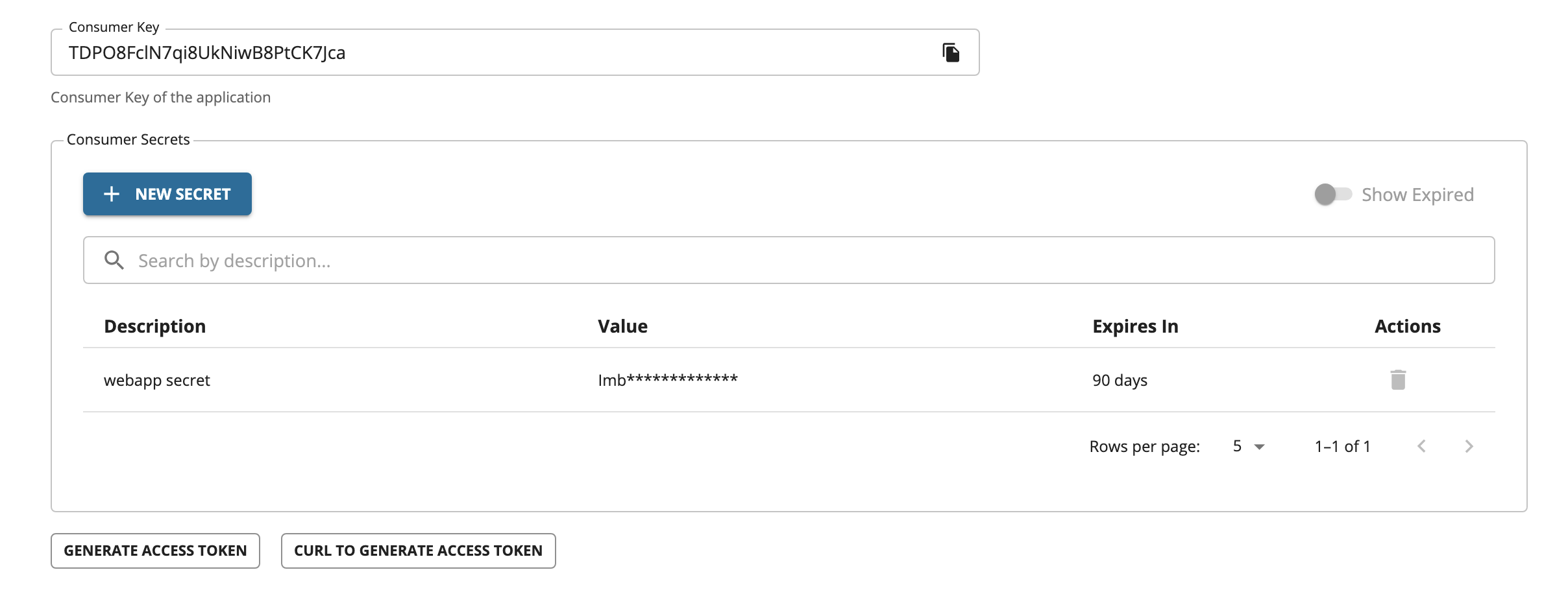
From WSO2 API Manager 4.7.0 onwards, applications support multiple consumer secrets. Each consumer secret can optionally include a description and expiry time. Consumer secrets are masked in the Developer Portal and are displayed only at the time of generation
Important
Securely store consumer secrets after generation. Once a consumer secret is generated, it cannot be viewed again. Make sure to record all existing and newly generated secrets securely, as previously generated secrets will not be retrievable from the Developer Portal.
To configure this behavior, see Configure Multiple Consumer Secrets. To disable multiple consumer secrets and have the previous behaviour of having a single consumer secret per application, see Disable Multiple Consumer Secrets.
Generating application keys
Follow the instructions below to generate/renew application keys:
-
Sign in to WSO2 API Developer Portal (
https://<hostname>:9443/devportal). -
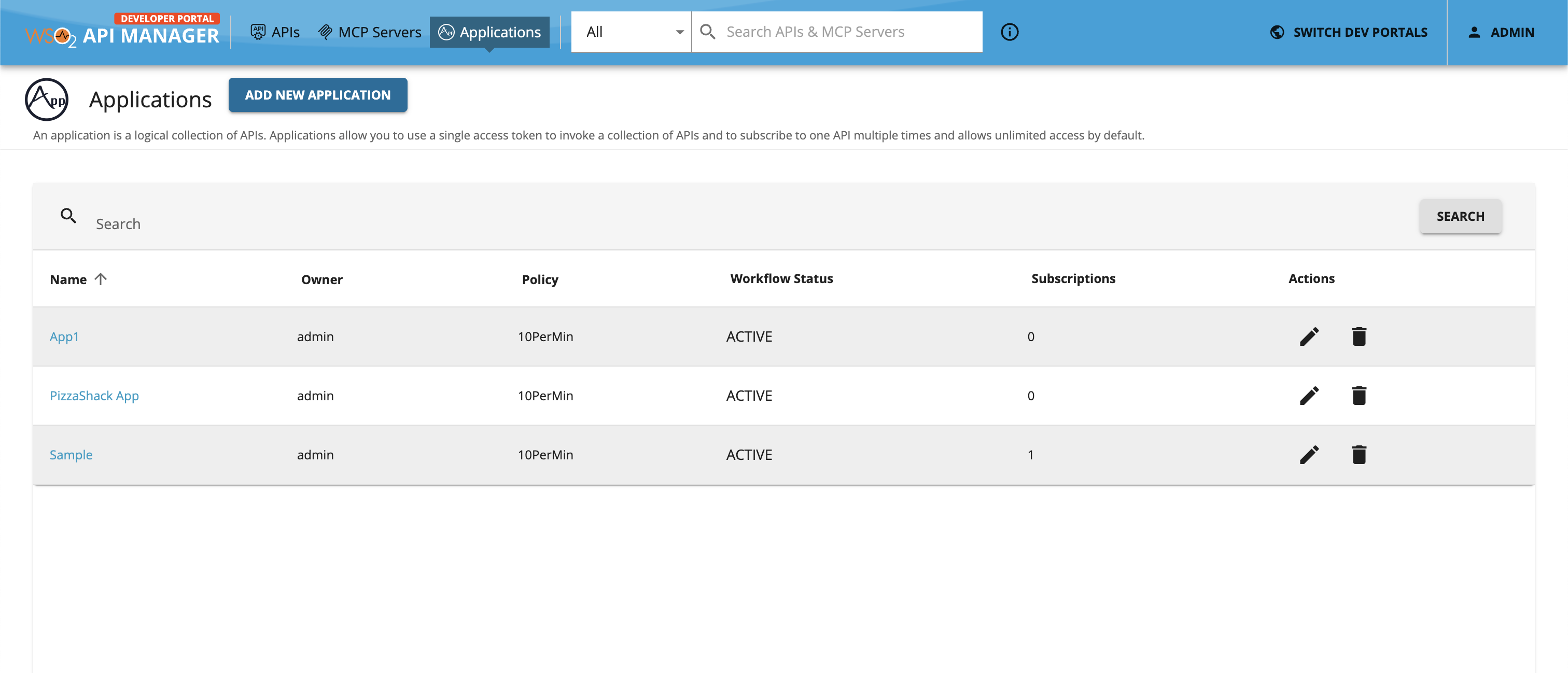
Click Applications to navigate to the applications listing page and click on the respective application for which you want to generate keys.
-
Click Production Keys or Sandbox Keys based on the environment for which you need to generate keys.
Let's assume that you are working in a production environment. Therefore, click Production Keys.
-
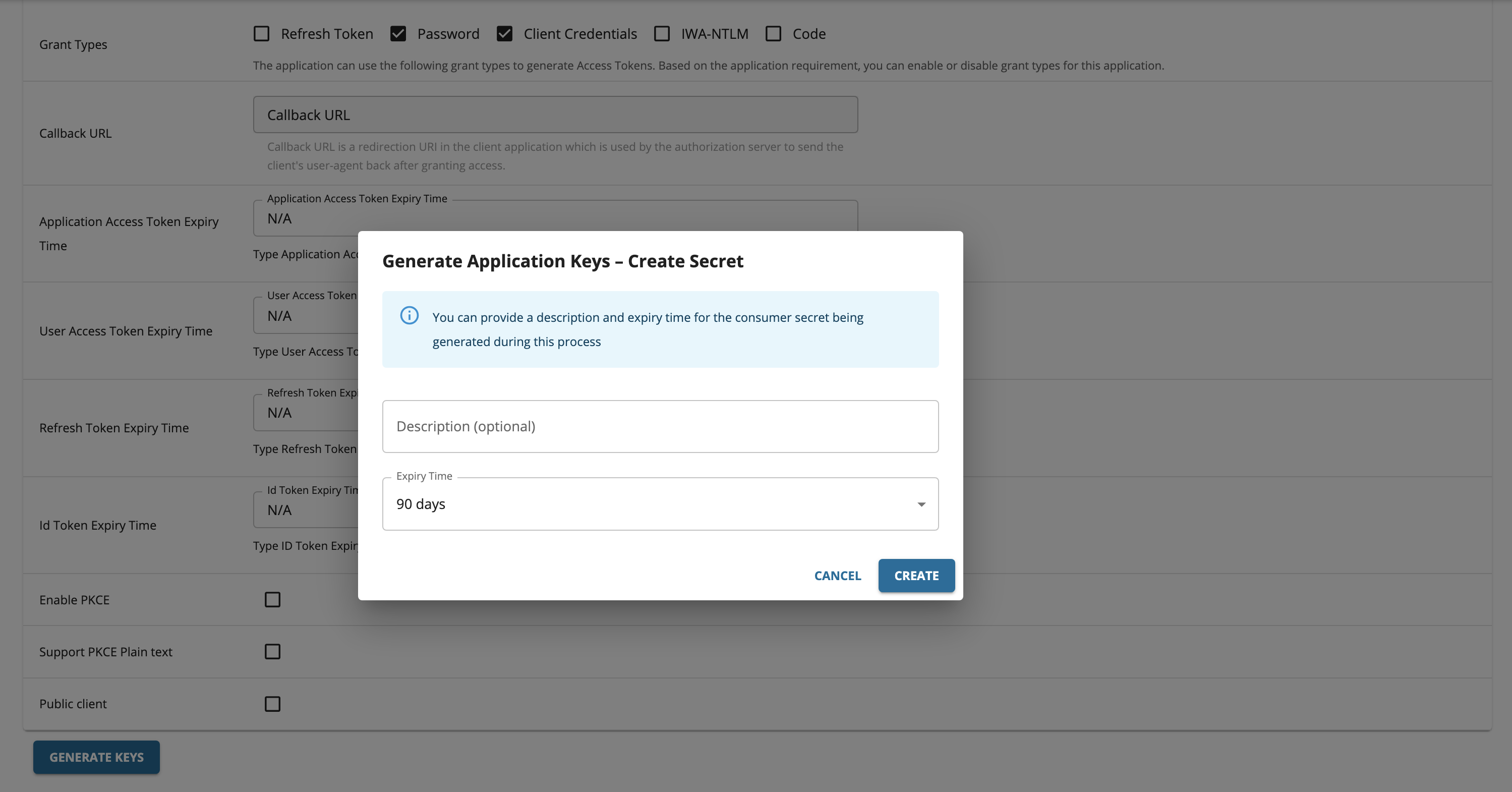
Click Generate Keys to create the consumer key and secret pair.
An optional description and expiry time can be provided for the consumer secret which will be generated.
-
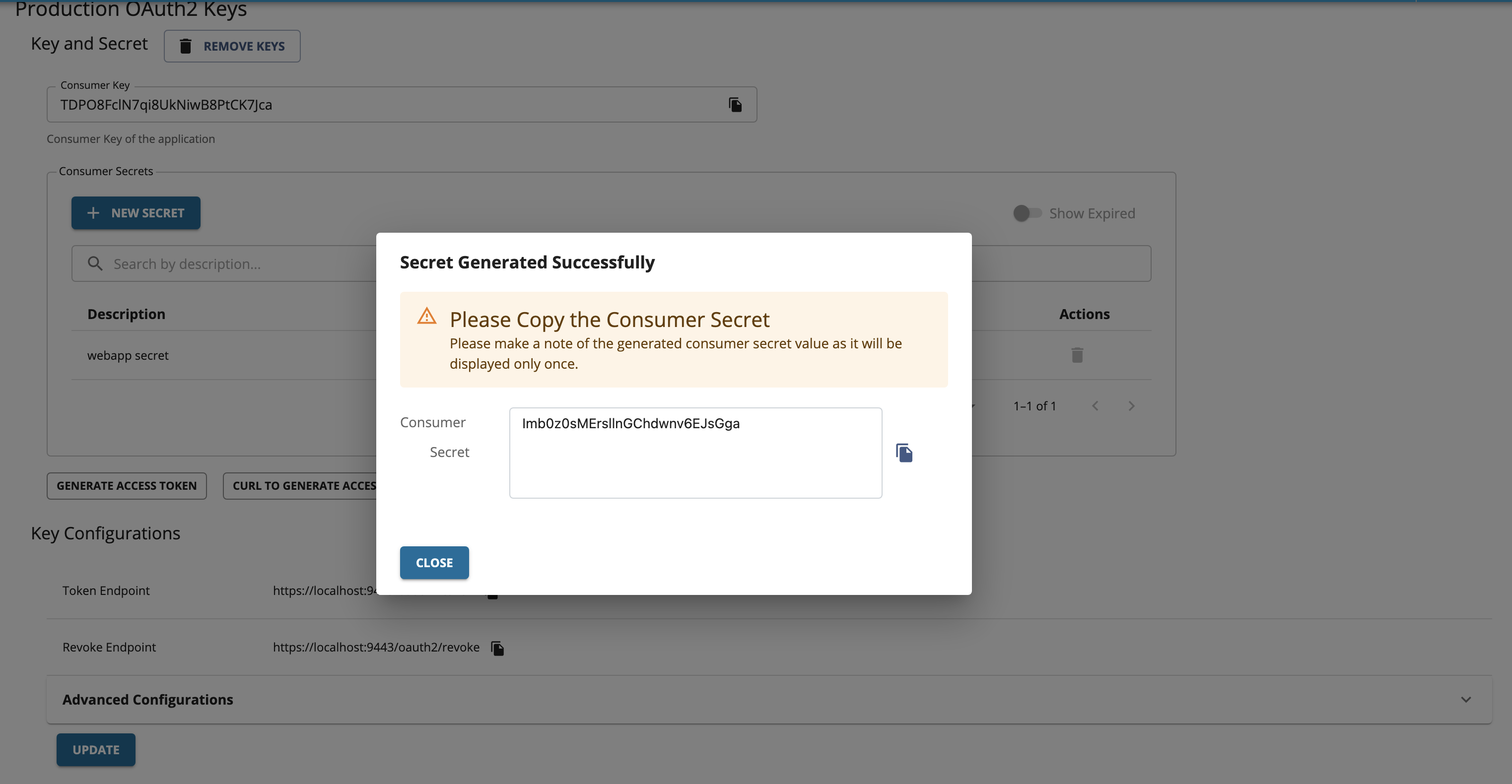
The generated consumer secret will be displayed.
Important
Make sure to copy the generated consumer secret as it will be displayed only once.
-
The consumer secret list will be displayed in a table.
-
To generate another consumer secret, click + NEW SECRET button. A form will be shown where an optional description and expiry time can be provided for the consumer secret which will be generated.
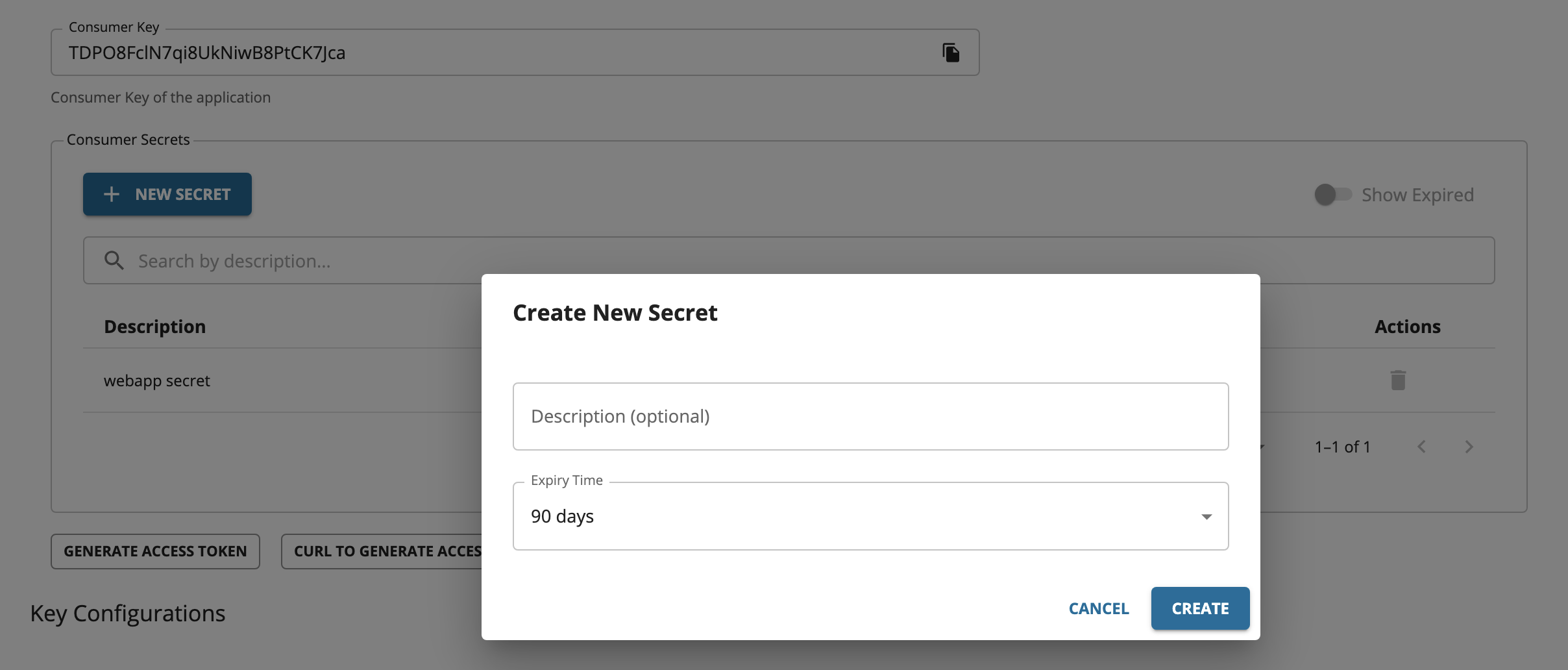
The generated consumer secret will be displayed. Make sure to copy the generated consumer secret as it will be displayed only once.
-
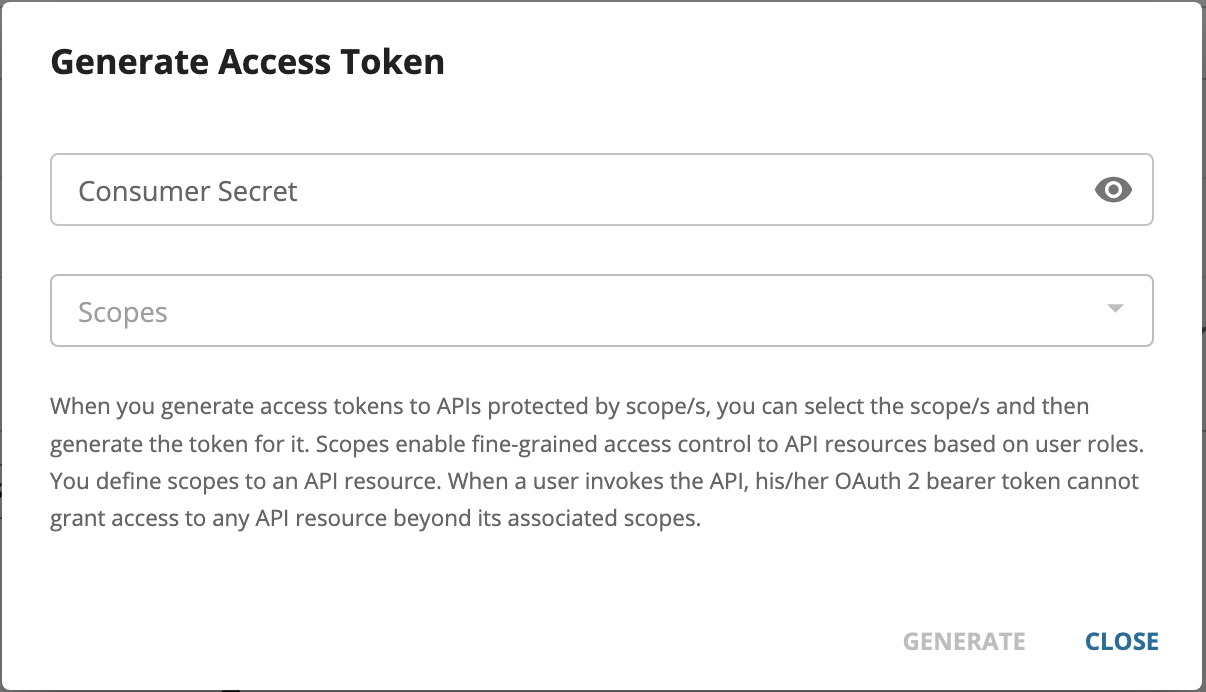
Two consumer secrets are now available for the application. Access tokens can be generated using any of the available consumer secrets associated with the application. To generate an access token, click GENERATE ACCESS TOKEN. When prompted, provide one of the consumer secrets associated with the application.
-
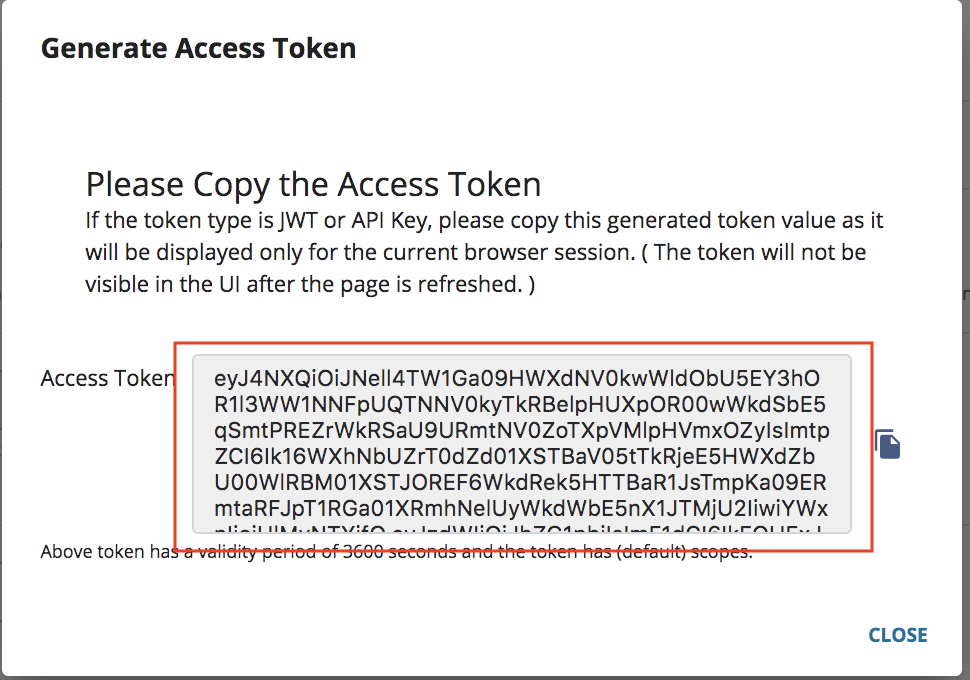
Copy the generated JWT Access Token that appears so that you can use it in the future.
Tip
When you generate Access Tokens for APIs that are protected by scopes, you can select the respective scopes and, thereafter, generate the token for it.
Deleting a Consumer Secret
-
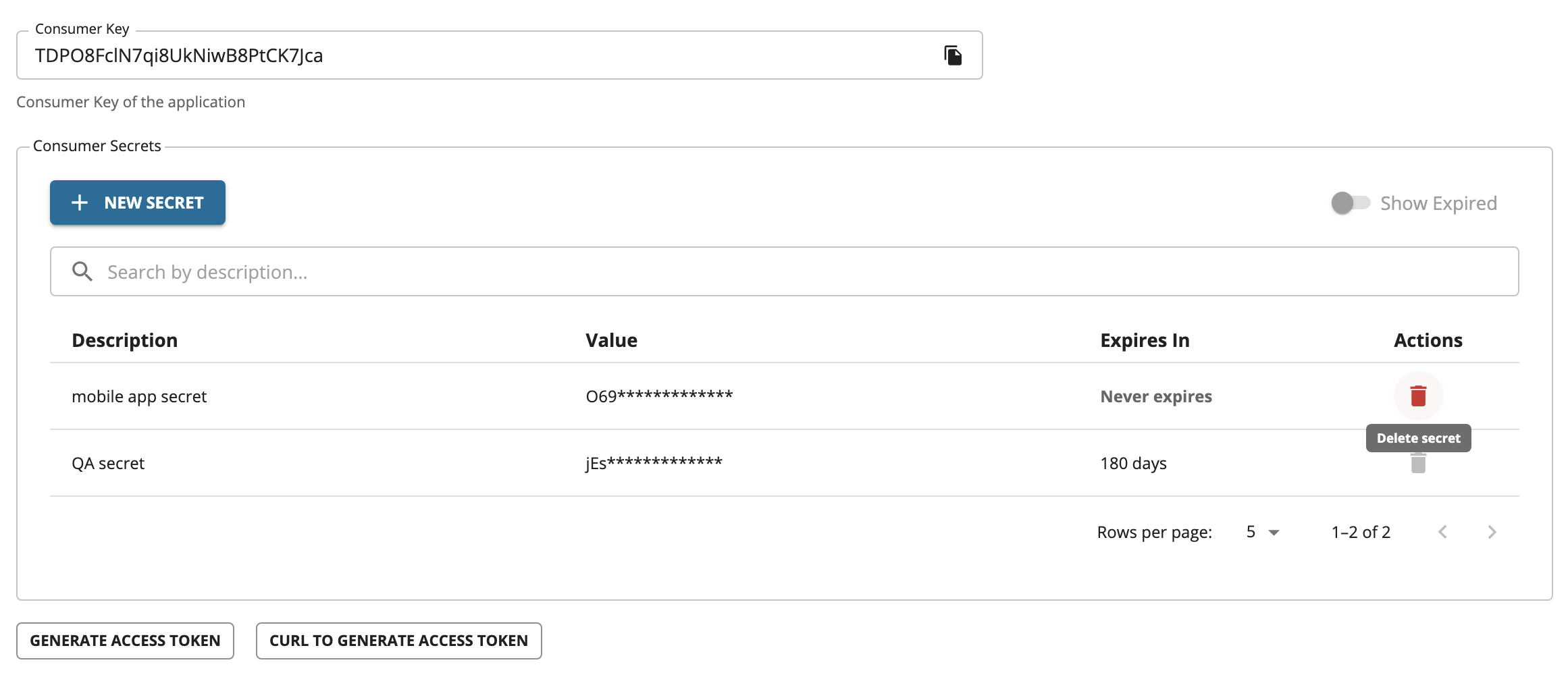
To delete a consumer secret, click the DELETE icon under the Actions column corresponding to the consumer secret which should be deleted.
-
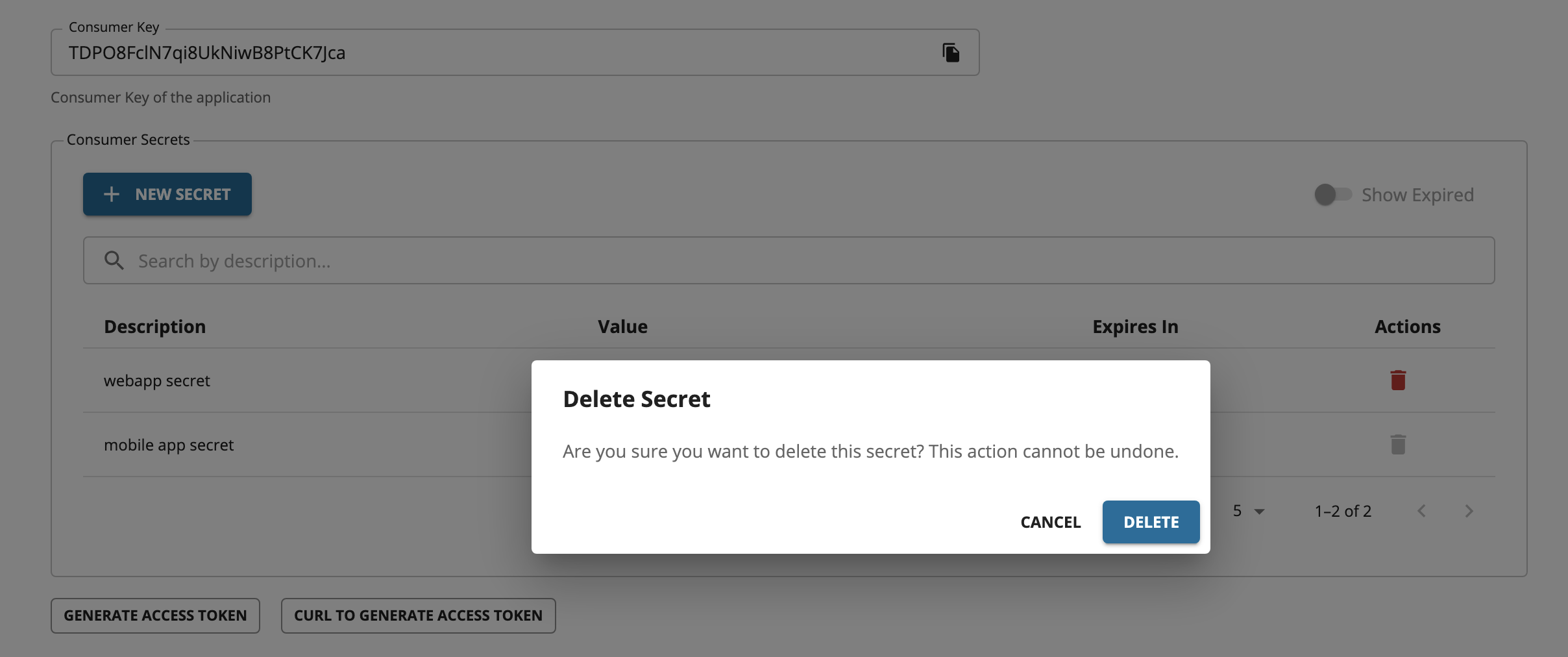
A confirmation box will be opened to verify whether the action was intended. Click DELETE to delete the consumer secret.
Note
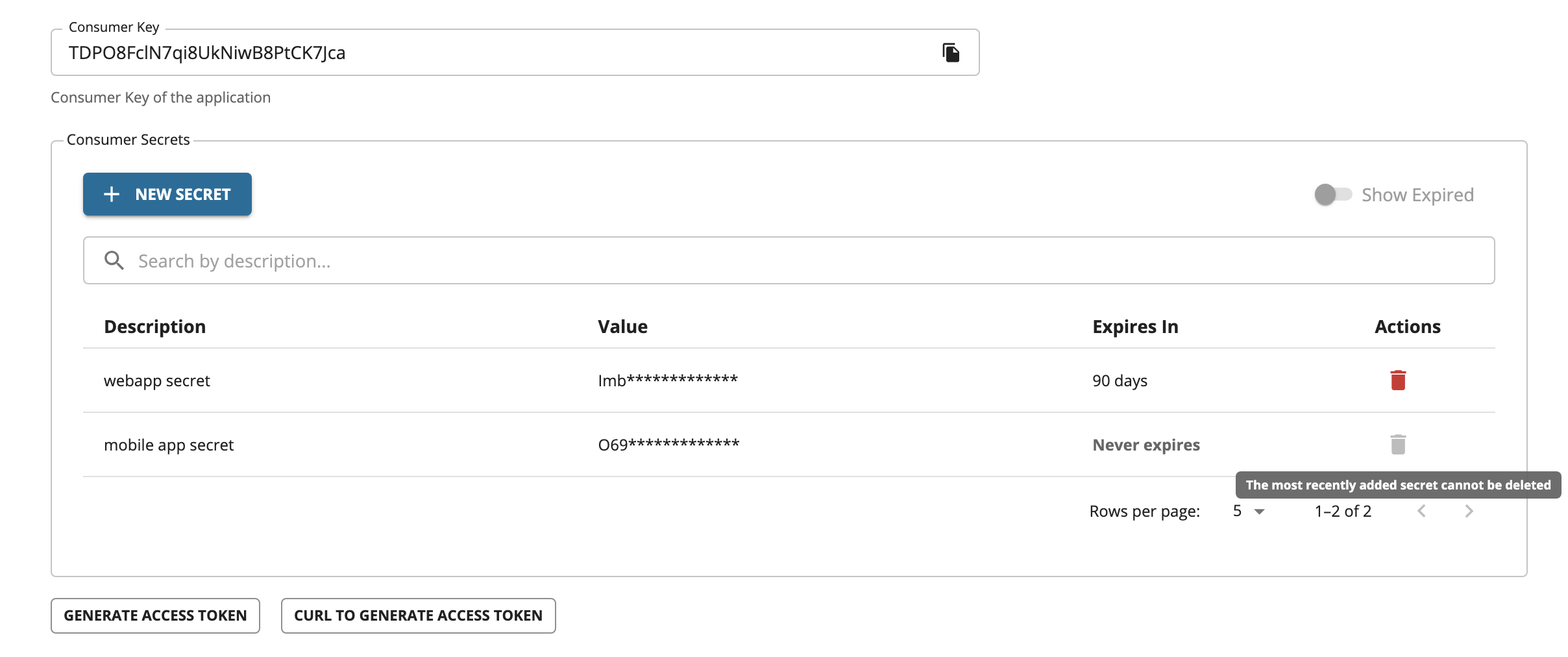
The most recently added consumer secret cannot be deleted because an application must always retain at least one consumer secret.
Important
Deleting a consumer secret does not revoke access tokens that were generated using that secret. These tokens will continue to remain valid until their configured expiry time. Therefore, it is recommended to use access tokens with the minimum required expiry time.
Configure multiple consumer secrets
You can configure multiple consumer secret behavior in <API-M_HOME>/repository/conf/deployment.toml.
Limit the number of consumer secrets per application
By default, an application can have an unlimited number of consumer secrets. To limit the number of secrets that can be created for an application, add the secret_count configuration:
[oauth.multiple_client_secrets]
secret_count = <SECRET_COUNT>
For example, to allow up to 5 consumer secrets per application, add the following configuration:
[oauth.multiple_client_secrets]
secret_count = 5
Disable multiple consumer secrets
To disable multiple consumer secrets and use the previous behavior (single consumer secret per application), add the following configuration:
[oauth.multiple_client_secrets]
enable = false
Generating application keys with PKCE enabled
Proof Key for Code Exchange (PKCE) is a commonly used security measure to secure the applications that are executing in the same domain. For example, two mobile applications running on a single device can get the other application's Auth code and request a token if the domain is the same. You can use PKCE to overcome the latter mentioned issue.
To enable PKCE, you need to select the Enable PKCE option as shown below when generating the keys.
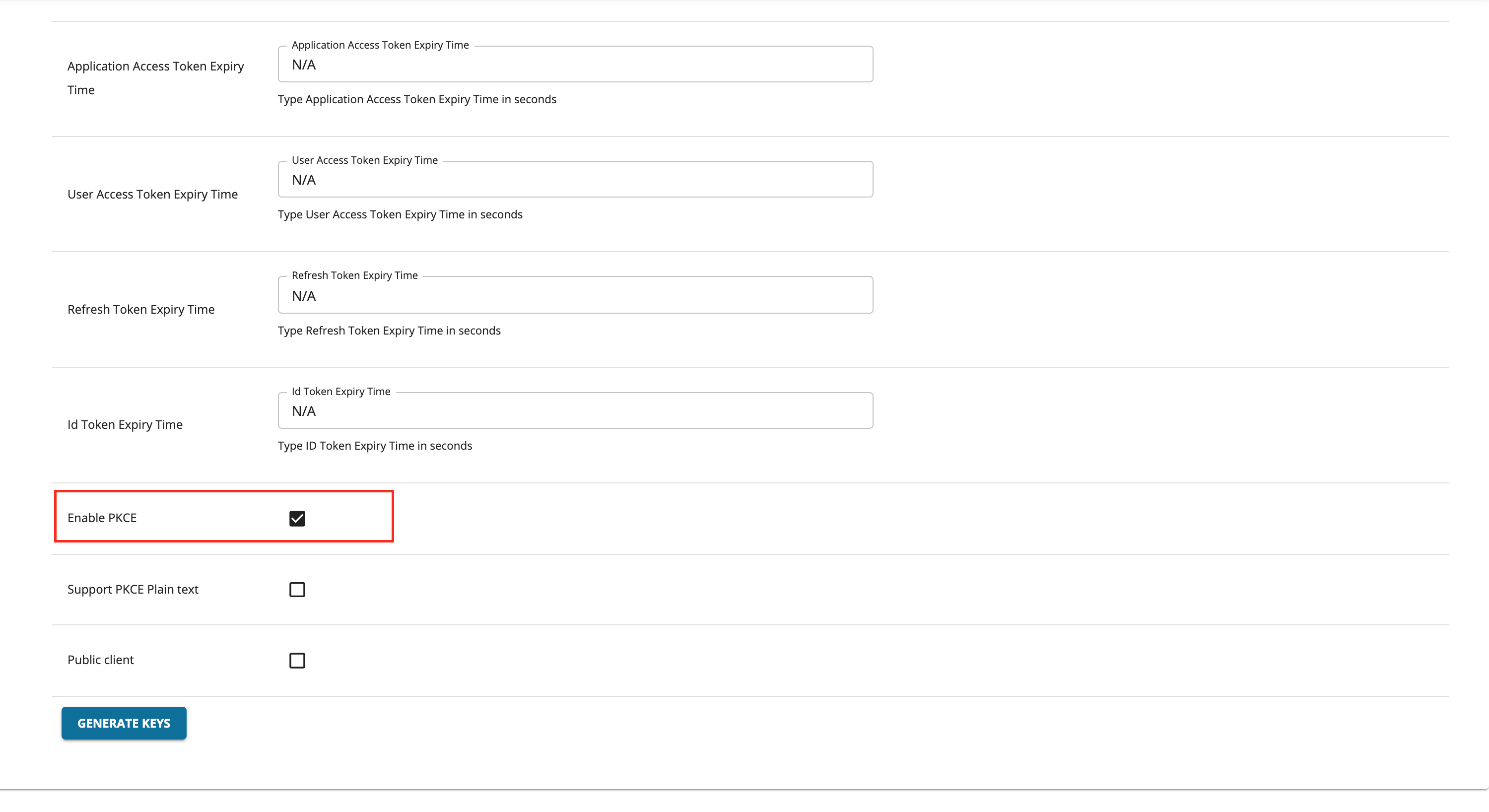
The following are the associated options when enabling PKCE.
-
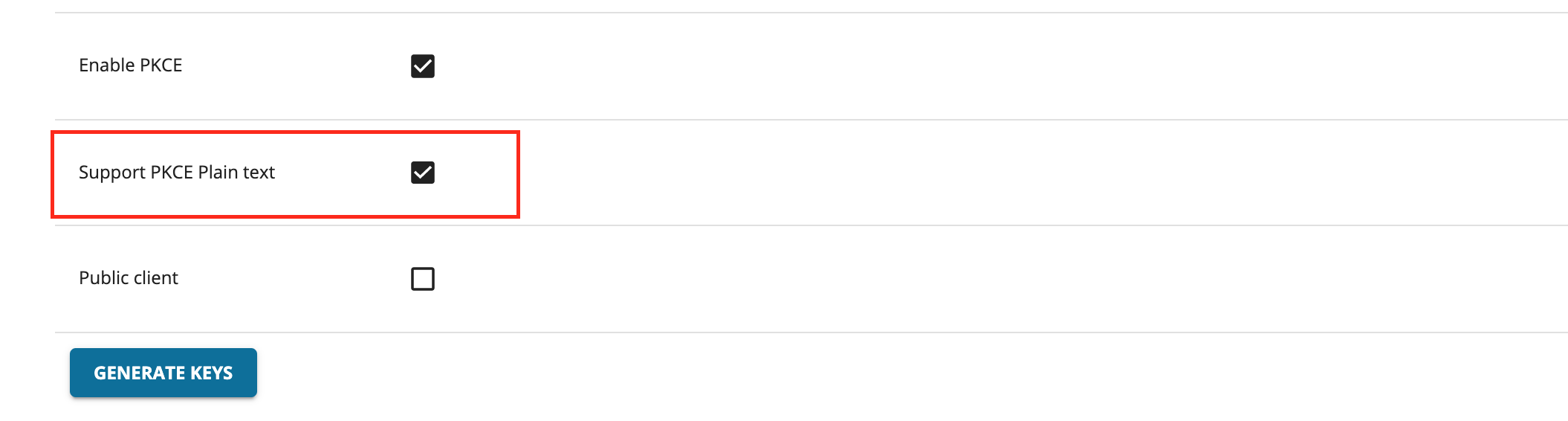
Support PKCE Plain Text
When this option is enabled, the code challenger and code verifier used will be in plain text. The recommended way is to use a SHA 256 algorithm, which is the default value when this option is not selected.
-
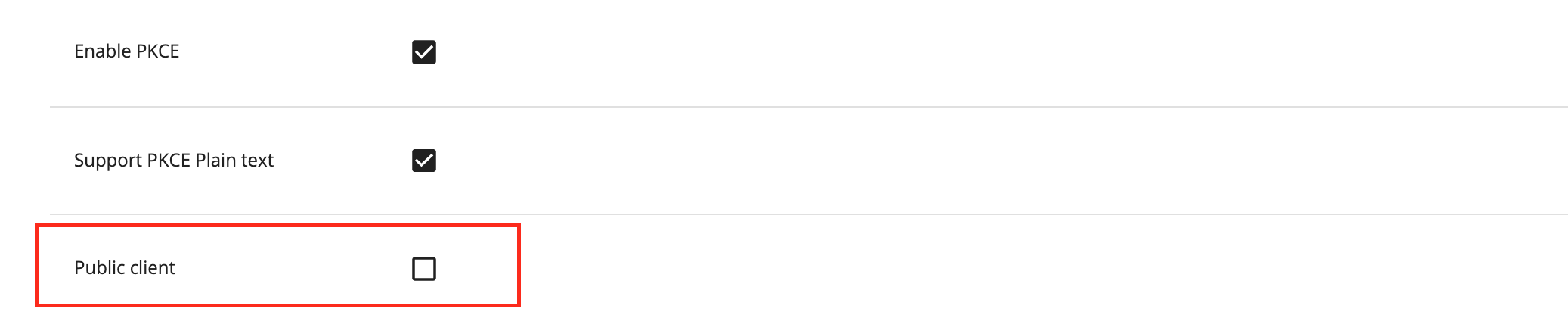
Public Client
This option will allow the client to be authenticated without the secret.
Generating application keys using Okta
Note
Before you begin, make sure to follow steps 1 and 2 in Configure Okta as a Key Manager guide.
Follow the instructions below to generate keys using Okta as the Key Manager:
-
Sign in to WSO2 API Developer Portal (
https://<hostname>:9443/devportal). -
Click Production Keys or Sandbox Keys based on the environment for which you need to generate keys.
If you are working in a production environment, click Production Keys.
-
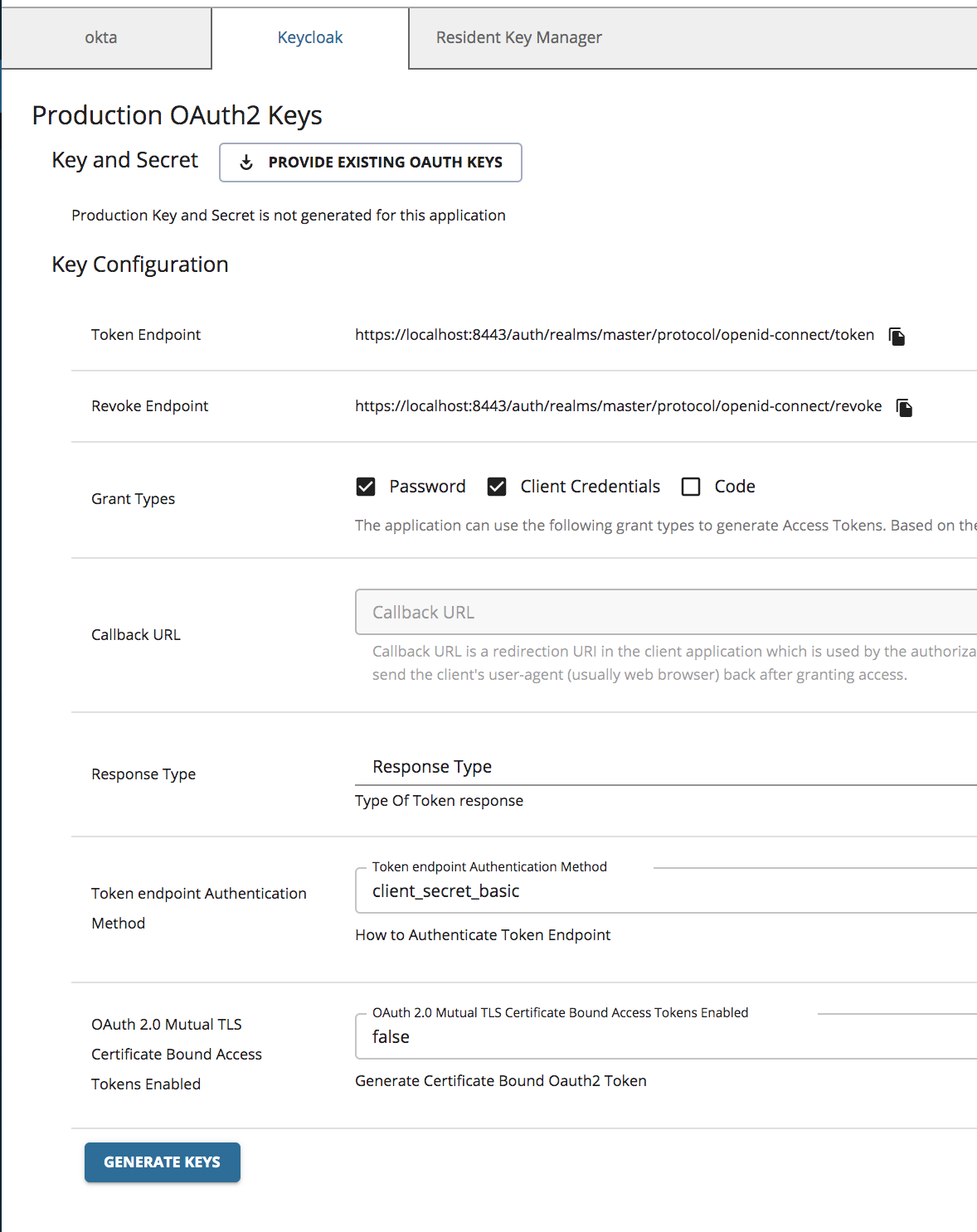
Click Okta.
-
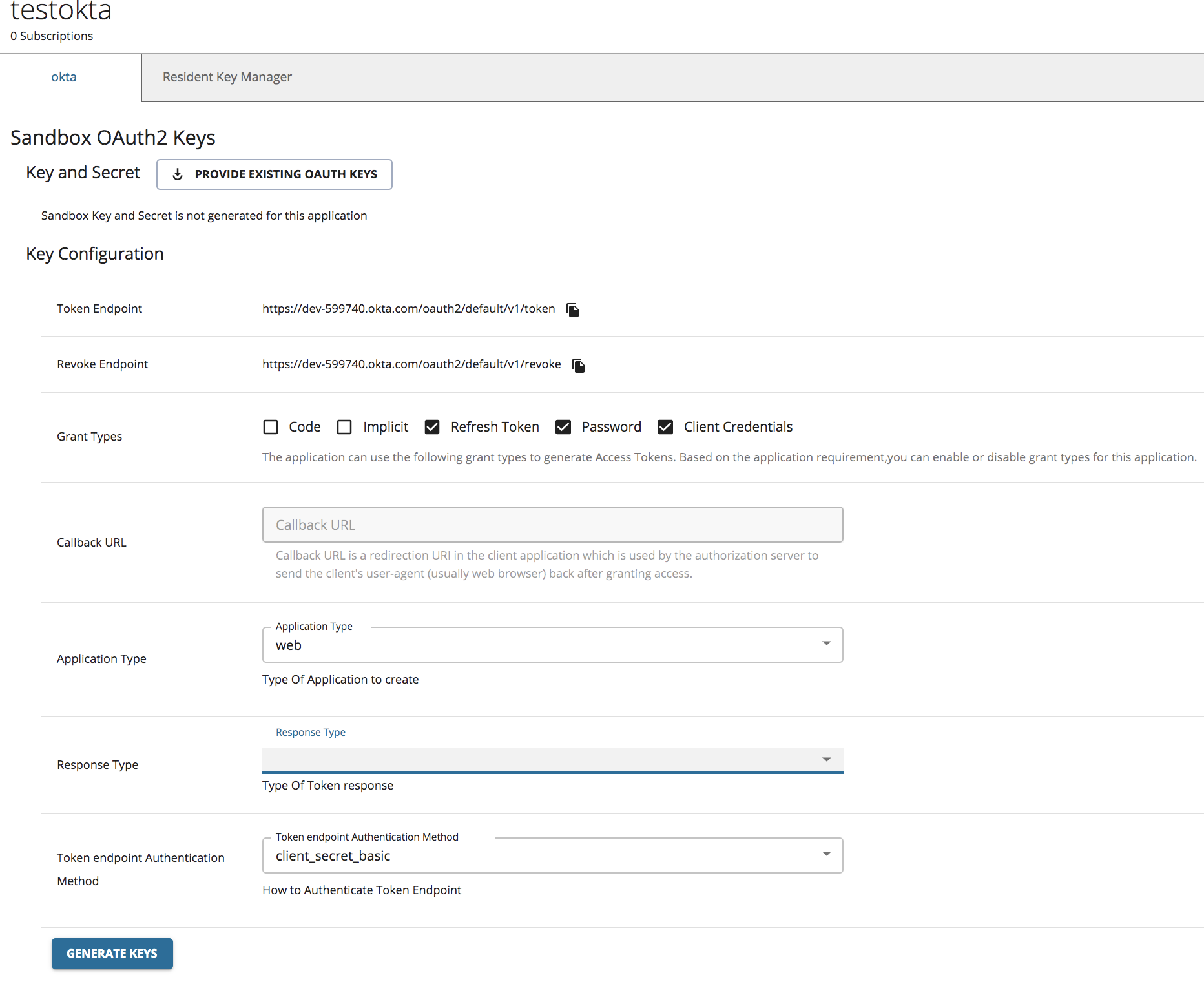
Click Generate Keys to create an application Access Token.
Info
For more information on the client application properties that need to be set, see the Okta documentation.
Note
If you need an Access Token with scopes, make sure that you have created the scopes in advance on the Okta side.
Generating application keys using Keycloak
Note
Before you begin, make sure to follow steps 1 and 2 in Configure Keycloak as a Key Manager guide.
Follow the instructions below to generate keys using the Keycloak as the Key Manager:
-
Sign in to WSO2 API Developer Portal (
https://<hostname>:9443/devportal). -
Click Production Keys or Sandbox Keys based on the environment for which you need to generate keys.
If you are working in a production environment, click Production Keys.
-
Click Keycloak.
-
Click Generate Keys to create an application access token.